Edition 3
The third edition of the SBE Student Challenge invited students to design a new contemporary road bridge, taking into account technical, landscape, and aesthetic perspectives. Unlike editions 1 and 2, several workshop days were organized at SBE’s offices, where participants could work on their designs.
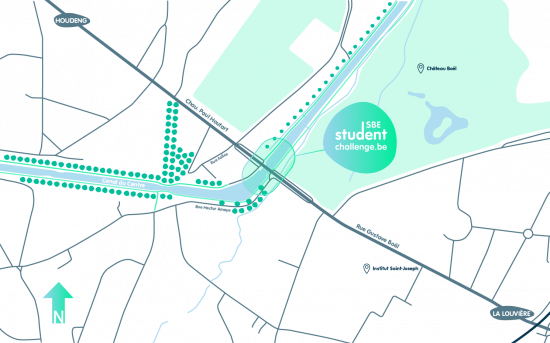
Road Bridge as Protected UNESCO Heritage
Along the canal, with its characteristic rows of trees, the boat lifts form a remarkably well-preserved example of a high-tech industrial landscape from the late 19th century. The four boat lifts are the only ones in the world still existing in their original working condition. It is therefore no surprise that this ensemble is protected as UNESCO World Heritage.
The Pont Capitte, one of the road bridges crossing the canal, is an important link between the city center of La Louvière and Houdeng along the Chaussée Paul Houtart.
The challenge
The existing bridge urgently needs to be replaced for several reasons:
Corrosion damage, which could eventually compromise stability;
The current sidewalks no longer comply with regulations (minimum width of 1.5 m);
The approach ramps of the fixed bridge are approximately 85 m long. As a result, the ramps extend deep between the row houses, leading to a significant reduction in living quality;
The service roads of the bridge conflict with the RAVeL (the Walloon equivalent of Flanders’ cycle highways), which is partly used by vehicles coming from the Chaussée Paul Houtart, creating dangerous situations.
The SBE Student Challenge invites students to design a new road bridge to replace the existing Pont Capitte. This design must also include the approach ramps of the bridge (including piers, abutments, foundations and/or earthworks) as well as the surrounding landscape design, ensuring proper integration with the existing environment and the RAVeL.
The new bridge design must address existing bottlenecks while also providing an opportunity to reconsider the bridge from an urban and landscape perspective, particularly given the goal of improving the quality of life in the surrounding area.
Of course, the new bridge must also integrate into the heritage landscape through a contemporary design. The following minimum technical requirements are provided:
Continuous bicycle traffic on both sides of the canal (RAVeL) must be maintained, preferably conflict-free;
The minimum navigable width over the watercourse is 6 m, with a minimum clearance height of 2.80 m above water level (suitable for recreational boating);
The new bridge must include at least: 2 sidewalks (min. 1.50 m), 2 bike lanes (min. 1.50 m), 2 traffic lanes (min. 3.00 m), and 1 bus lane (min. 3.50 m);
Design speed on the Chaussée Paul Houtart over the bridge: 50 km/h;
Bridge railing with a minimum height of 1.20 m.
Kick-off
Watch the recording of the kick-off of the design competition, edition 3, here.

The winners

About four months after the launch of our competition, the moment had finally arrived: the jury’s decision, the closing event of the SBE Student Challenge. The teams presented their designs one by one, and the jury selected the winners.
Congratulations to Cas Neels, Frédéric Berges, and Kobe Gielen!
Of course, we would also like to thank the other #studentsatplay for their participation, dedication, and motivation.
The winning design was not chosen lightly. The jury appreciated how the winning team presented a complete story through their design. The brief was used as a starting point for a design that also positively transforms the surrounding area. The bridge design itself remains subtle, with a nod to the steel truss elements so characteristic of the boat lifts along this UNESCO-protected canal view.
The Jury


