Edition 1
Our very first edition of the SBE Student Challenge challenged architecture and civil engineering students from UGent to design an urban, architectural, and structural concept for a cycling bridge over the Leie in Zulte.
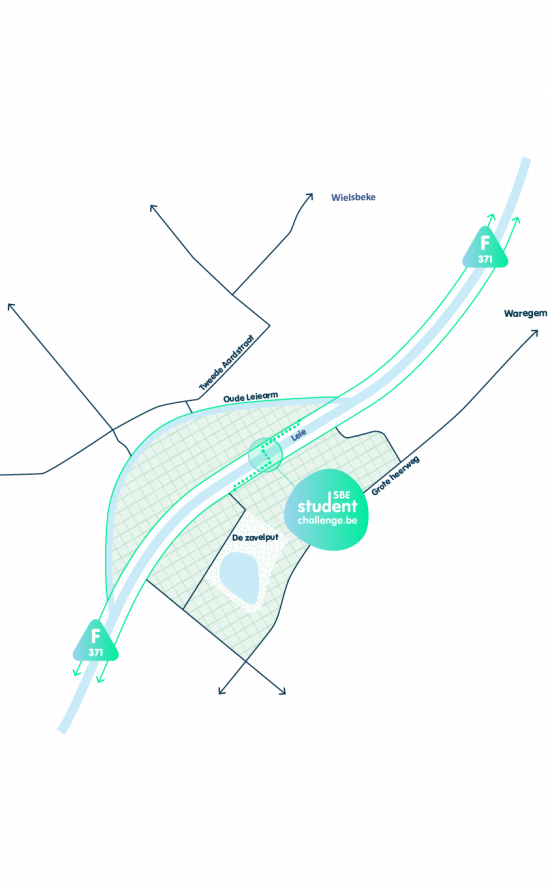
Cycling bridge over the Leie
Overall Vision
The cycling bridge in this design competition is part of the Seine-Scheldt project by De Vlaamse Waterweg NV, a large-scale shipping project in Belgium and France that includes the widening of the Leie. Alongside these mobility works, there is a strong focus on water management and enhancing life on and along the waterways—from livability and recreation to environmental protection—making this cycling bridge an important link for society as a whole.
The construction of cycling bridges is a prime example of this approach.
Context
The cycling bridge to be designed aims to support the tourism and recreational character of the Leie region. The goal is to develop the area for short vacations while further promoting and expanding its recreational opportunities. The construction of this bridge will refine the recreational cycling network along the Leie itself and its connections to the wider region. On a smaller scale, it will also restore the historic connection between the center of Zulte and the Castle of Lake.
The new cycling bridge will additionally create opportunities for the functional cycling network by linking and connecting routes. The new route will connect the Limnanderdreef and the F371 cycling highway towards Wielsbeke.
Finally, this cycling bridge will be part of a family of bridges over the Leie, consistent in both design and use.
The Challenge
Collaboration across disciplines was central to this design competition. Each team consisted of a maximum of four students, with a mix of architecture and civil engineering students.
The architectural and technical design had to include at least the following elements:
A new (non-movable) cycling bridge over the Leie, including abutments and foundations as required, taking potential “sister bridges” into account.
Approach ramps for the cycling bridge, including piers and foundations as required.
Optional staircases on the cycling bridge for pedestrians, including piers and foundations.
Environmental works, such as:
Relocating and constructing towpaths to connect with existing roads if needed;
Sloped approach ramps;
Wadis and ecological riverbanks;
…
Kick-off
Watch the recording of the kick-off for the first edition of the design competition here.

The winners
Participating is more important than winning, but being crowned the winner of our design competition is certainly the icing on the cake!
The team of Janne Cauwels, Simon Vanlaere, Tom De Koninck, and Wolf-Simon Fleuren presented a strong design and were thus awarded the winning team of this first SBE Student Challenge.
Congratulations!


We really enjoyed participating. The competition provided a great opportunity to collaborate with students from other fields.
The jury


